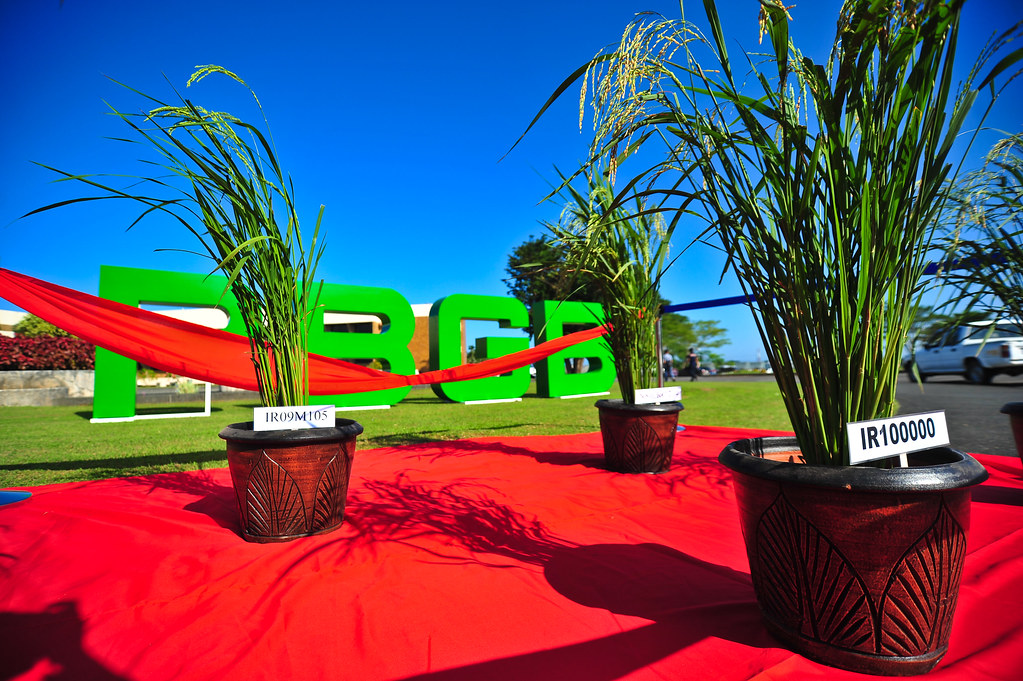
Rice breeding in IRRI marked a milestone in the Institute's mission to help feed the world—its 100,000th cross.
A simple yet meaningful gathering to mark the breeding milestone was held on 29 November 2012 at N.C. Brady Laboratory in IRRI, which houses the Plant Breeding, Genetics, and Biotechnology division. The event was attended by IRRI staff and members of management, as well as retired breeders who saw through the early years of breeding in IRRI.
Glenn Gregorio, deputy head of the breeding division, dubbed ricebreeding work as a “tedious way of matchmaking.”
“IRRI has been in existence for more than 50 years and, with the vast diversity at our disposal through the Genebank, we have been making about 2,000 crosses a year,” says Dr. Gregorio. “Our 100,000th—or IR100K—is a cross between the high-yielding NSICRc 214 and IR09M105, a high-nutrient variety.”
One of those who witnessed the unveiling of IR100K was retired assistant scientist Rizal Herrera. Mr. Herrera joined IRRI in 1961 as farm aide, and soon after, transferred to the laboratories. He was one of the first who made crosses at IRRI. “I made my first cross in 1971, and came up with the idea of the vacuum emasculator—a device that made our breeding work 50% more productive.” Mr. Herrera shared.
More than four decades since the release of the first IRRI-bred variety—IR8, or "miracle rice"—IRRI continues to take to heart the principles of its foundation: to help secure food for humanity.
Eero Nissila, head of IRRI's breeding division, noted during a short speech in the ceremony that IRRI has released close to 900 varieties all over the world.
Learn more about IRRI (www.irri.org) or follow us on the social media and networks (all links down the right column).
Selasa, 04 Desember 2012
Lao PDR: Success stories in irrigated rice presented
"It is worthwhile to invest in rice research,” said Carmen Thoennissen, senior advisor of the Federal Department of Foreign Affairs of the Swiss Agency for Development and Cooperation or SDC.
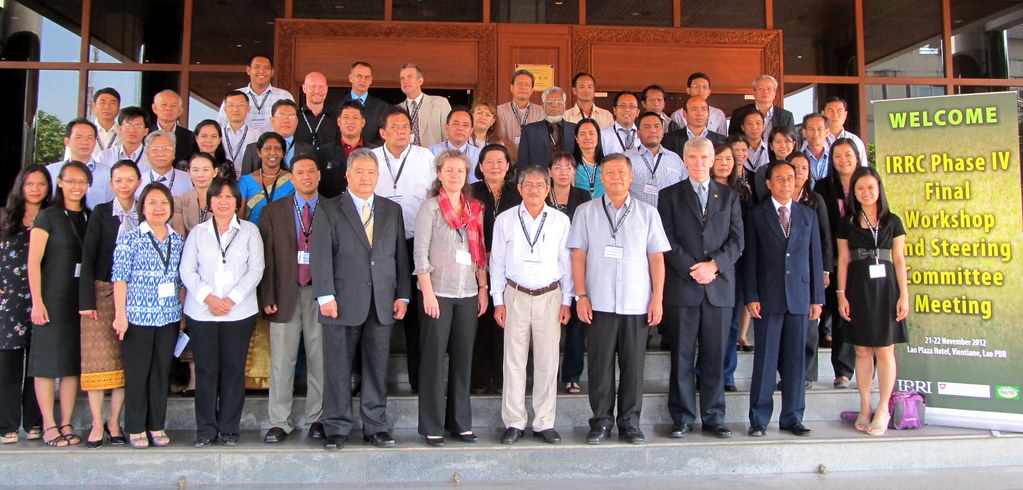
Dr. Thoennissen's remark sums up assessment of and discussions held at the conclusion of Phase IV of the work of the Irrigated Rice Research Consortium (IRRC). Key success stories from Phase IV were presented and discussed at a workshop and steering committee meeting held in Vientiane, Lao PDR, on 21–22 November2012.
More than 50 participants from 10 Asian countries came to theworkshop in which the outcomes and impacts of the IRRC over the past four years were discussed.
A highlight of the event was a preliminary report from an international panel that is considering the impacts of the IRRC since its inception in 1997.
The SDC ends its 16-year funding of the IRRC in December 2012. The IRRC will continue beyond 2012 in a refined version. The SDC will then fund a new 8-year project on closing rice yield gaps in Asia, or CORIGAP, that will be managed under the IRRC umbrella.
Dr. Thoennissen praised IRRI's Grant Singleton for his work as coordinator of the IRRC over the past 7 years, affirming that he has been the “perfect person” for the job. She gave a presentation to Dr. Singleton on behalf of IRRI and the SDC.
Bas Bouman, director of the Global Rice Science Partnership, described once working with the IRRC as a “rich and rewarding” experience.
Workshop and meeting participants were steering committee members (Bounthong Buouhom, chair; Jesie Binamira; Pham Van Du; U Than Aye, standing in for the Myanmar representative; Dr. Thoennissen; and Dr. Bouman), IRRI staff, IRRC coordination unit staff, IRRC workgroup leaders, and various country partners.
V. Bruce J. Tolentino, deputy director general for communications and partnerships at IRRI, was also present during the event.
Learn more about IRRI (www.irri.org) or follow us on the social media and networks (all links down the right column).
Dr. Thoennissen's remark sums up assessment of and discussions held at the conclusion of Phase IV of the work of the Irrigated Rice Research Consortium (IRRC). Key success stories from Phase IV were presented and discussed at a workshop and steering committee meeting held in Vientiane, Lao PDR, on 21–22 November2012.
More than 50 participants from 10 Asian countries came to theworkshop in which the outcomes and impacts of the IRRC over the past four years were discussed.
A highlight of the event was a preliminary report from an international panel that is considering the impacts of the IRRC since its inception in 1997.
The SDC ends its 16-year funding of the IRRC in December 2012. The IRRC will continue beyond 2012 in a refined version. The SDC will then fund a new 8-year project on closing rice yield gaps in Asia, or CORIGAP, that will be managed under the IRRC umbrella.
Dr. Thoennissen praised IRRI's Grant Singleton for his work as coordinator of the IRRC over the past 7 years, affirming that he has been the “perfect person” for the job. She gave a presentation to Dr. Singleton on behalf of IRRI and the SDC.
Bas Bouman, director of the Global Rice Science Partnership, described once working with the IRRC as a “rich and rewarding” experience.
Workshop and meeting participants were steering committee members (Bounthong Buouhom, chair; Jesie Binamira; Pham Van Du; U Than Aye, standing in for the Myanmar representative; Dr. Thoennissen; and Dr. Bouman), IRRI staff, IRRC coordination unit staff, IRRC workgroup leaders, and various country partners.
V. Bruce J. Tolentino, deputy director general for communications and partnerships at IRRI, was also present during the event.
Learn more about IRRI (www.irri.org) or follow us on the social media and networks (all links down the right column).
Indonesia: Training on fan testing held in South Sumatra
Twenty participants from the academe, manufacturing, and the government extension arm attended a training event on fan testing and evaluation.
The training course had emphasis on fan testing procedures, data gathering, and data analysis and included an open forum for discussing issues in postharvest, particularly paddy dryer operation.
Participants did the actual fan testing during the training. Proper matching of dryer components and proper dryer operation were discussed by IRRI's Pat Borlagdan. A properly fabricated fan is critical for dryers.
The training was held on 26-28 November 2012 at a fabrication workshop that was handling a job order involving 30 flatbed dryers from government and private clients. It was organized by the postproduction workgroup of the Irrigated Rice Research Consortium (IRRC), in collaboration with the Assessment Institute for Agricultural Technologies in Palembang, South Sumatra.
The IRRC postproduction workgroup is managed by Martin Gummert, engineer and scientist at IRRI.
Learn more about IRRI (www.irri.org) or follow us on the social media and networks (all links down the right column).
The training course had emphasis on fan testing procedures, data gathering, and data analysis and included an open forum for discussing issues in postharvest, particularly paddy dryer operation.
Participants did the actual fan testing during the training. Proper matching of dryer components and proper dryer operation were discussed by IRRI's Pat Borlagdan. A properly fabricated fan is critical for dryers.
The training was held on 26-28 November 2012 at a fabrication workshop that was handling a job order involving 30 flatbed dryers from government and private clients. It was organized by the postproduction workgroup of the Irrigated Rice Research Consortium (IRRC), in collaboration with the Assessment Institute for Agricultural Technologies in Palembang, South Sumatra.
The IRRC postproduction workgroup is managed by Martin Gummert, engineer and scientist at IRRI.
Learn more about IRRI (www.irri.org) or follow us on the social media and networks (all links down the right column).
Philippines: CURE hosts IFAD’s 5th country review
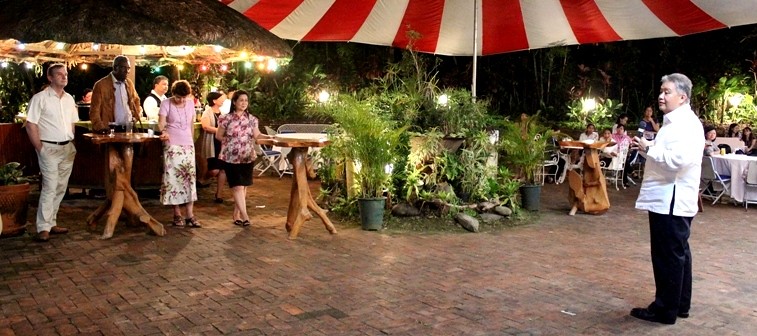
| V. Bruce J. Tolentino, IRRI's head of communications and partnerships, addresses ACPoR participants in a dinner hosted by CURE at the IRRI Guesthouse. |
During the ACPoR, participants review implementation experiences, share project good practices, discuss problems encountered, and find solutions to improve program or project performance.
This year’s review, held on 28–29 November 2012 at IRRI headquarters in Los BaƱos, Laguna, had the theme, Managing information and knowledge in delivering impact across project cycle.
Participants to the fifth ACPoR were representatives from these IFAD-supported projects: Rural Micro Enterprise Promotion Programme (RuMEPP) under the Department of Trade and Industry (DTI); Second Cordillera Highland Agricultural Resource Management Project (CHARMP2) under the Department of Agriculture (DA); Rapid Food Production Enhancement Programme (RaFPEP) under DA, which has two sub-projects: Rapid Seed Supply Financing Project (RaSSFiP) and Irrigated Rice Production Enhancement Project (IRPEP); IFAD Medium Term Cooperation Programme (MTCP)-Philippine Farmers’ Forum (PhilFaFo), World Agroforestry Centre (ICRAF)-Rewards for, Use of and Shared Investment in Pro-poor Environmental Services Schemes (RUPES), International Potato Center (CIP), IRRI-CURE, National Economic Development Authority (NEDA), Department of Trade and Industry (DTI), Department of Agriculture (DA), Department of Agrarian Reform (DAR), Department of Environment and Natural Resources (DENR), and the COSOP Reviewers. Also present were upcoming and new project entrants: the Integrated Natural Resource and Environmental Management Project (INREMP) under DENR and Convergence on Value Chain-Enhancement for Rural Growth and Empowerment (CONVERGE) under DAR.
This year’s ACPoR was held back-to-back with IFAD-Philippines’ 6th Knowledge and Learning Market or KLM, held on 27 November 2012 at Richmonde Hotel in Ortigas, Pasig City. The KLM is an event for knowledge-sharing among policymakers, IFAD projects, and implementing government agencies and partners. It is also an interaction point with the general public through information-sharing.
Learn more about IRRI (www.irri.org) or follow us on the social media and networks (all links down the right column).
Second offering of RDM 201 course for IRRI staff
The second offering of the Research Data Management 201: Advanced SQL was held on 27-29 November 2012 in IRRI.
In RDM 201, some advanced functions and queries that can be useful when building more complex applications were introduced. The course was also a refresher on basic database management skills, taught by having participants look at and define the structure of a relational database system, compared to the hierarchal model of handling data.
Participants, composed of 7 IRRI research staff, were also taught to identify denormalized data and correct data redundancy up to the third normal form.
The RDM 201 training team is composed of Menchu Bernardo, Icoy Mercado, and Dec Arreza of IRRI's Risk Management and Quality Assurance.
Learn more about IRRI (www.irri.org) or follow us on the social media and networks (all links down the right column).
In RDM 201, some advanced functions and queries that can be useful when building more complex applications were introduced. The course was also a refresher on basic database management skills, taught by having participants look at and define the structure of a relational database system, compared to the hierarchal model of handling data.
Participants, composed of 7 IRRI research staff, were also taught to identify denormalized data and correct data redundancy up to the third normal form.
The RDM 201 training team is composed of Menchu Bernardo, Icoy Mercado, and Dec Arreza of IRRI's Risk Management and Quality Assurance.
Learn more about IRRI (www.irri.org) or follow us on the social media and networks (all links down the right column).
Laboratory weighing scales ISO-calibrated
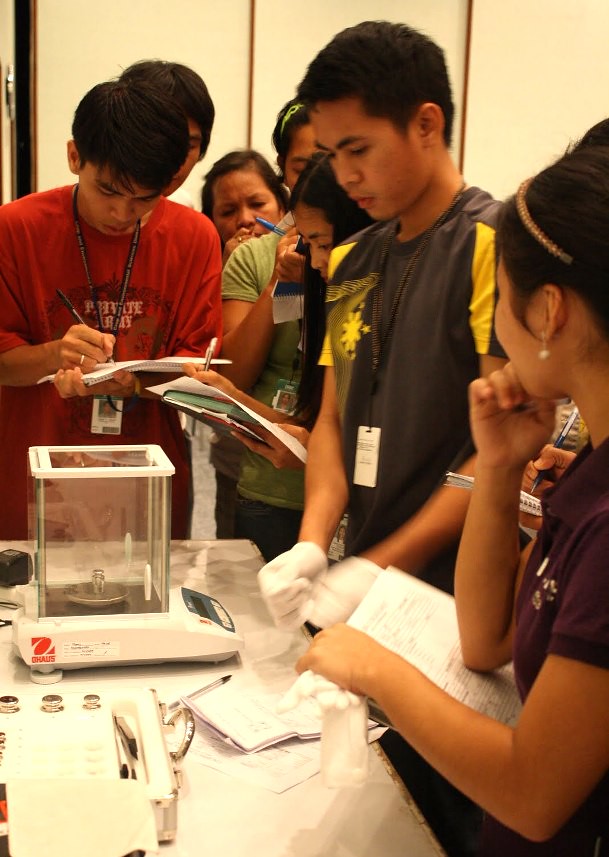
An institute-wide calibration of weighing scales is ongoing at IRRI on 27 November-7 December, as an initiative of IRRI's Risk Management and Quality Assurance team.
One hundred fourteen units from research, including analytical, top-loading, and bench scales will be calibrated by ISO 17025-accredited Metrologie Concepts Solutions. A calibration certificate is provided for each unit.
A scale is only as good as its ability to provide accurate measurements. In laboratories, weighing scales are workhorses and accuracy of measurement changes in time, due to wear and tear. Their proper handling and maintenance are thus very important.
The RMQA ensures that third party calibrations are performed regularly. The last one was made in 2009-10.
Learn more about IRRI (www.irri.org) or follow us on the social media and networks (all links down the right column).
Senin, 03 Desember 2012
African and Asian women train to be leaders of change
Twenty-five women from Africa and Asia came to IRRI for the 5-day Leadership course for African and Asian women in research and extension, an effort toward developing a cadre of women who can lead their respective institutions in addressing gender issues in research and in the workplace and facilitate the improvement of livelihoods of women in the grassroots.
The course aims to help women scientists, policymakers, research managers, project managers, and extension workers develop leadership skills and become effective agents of change in the agriculture sector.
Topics covered in the course were: concepts and mainstreaming of gender concerns in agriculture; research methods; interrelations among climate change, food security, and gender; leadership and project management; development of interpersonal and intrapersonal skills; business planning; and seed production.
To supplement the formal sessions, the women got their feet wet in the fields by transplanting rice seedlings and testing several farm machines. They also had the chance to interact with and interview women members of CARD, a Philippine microfinance institution based in Bay, Laguna.
The participants were from Togo, Benin, Senegal, Nigeria, Bangladesh, India, the Philippines, and Vietnam.
The course was held 19-23 November 2012 at the IRRI Training Center as a major output of the gender strategy under the Global Research in Science Partnership (GRiSP), and was the ninth time it was offered. It was coordinated by Thelma Paris, socioeconomist and gender specialist at IRRI, and Noel Magor, head of the Training Center.
The coordinating team acknowledges the support of Umesh Shankar Singh, coordinator of the STRASA Project in South Asia; and resource persons Bas Bouman, Gelia Castillo, Sylvia Avance, Eugenio Castro, Jr., Thelma Paris, Maria Socorro Arboleda, Alfred Schmidley, Joyce Luis, Maria Angeli Maghuyop, Anilyn Maningas, Macario Montecillo, and Priscilla Comia.
Learn more about IRRI (www.irri.org) or follow us on the social media and networks (all links down the right column).
The course aims to help women scientists, policymakers, research managers, project managers, and extension workers develop leadership skills and become effective agents of change in the agriculture sector.
Topics covered in the course were: concepts and mainstreaming of gender concerns in agriculture; research methods; interrelations among climate change, food security, and gender; leadership and project management; development of interpersonal and intrapersonal skills; business planning; and seed production.
To supplement the formal sessions, the women got their feet wet in the fields by transplanting rice seedlings and testing several farm machines. They also had the chance to interact with and interview women members of CARD, a Philippine microfinance institution based in Bay, Laguna.
The participants were from Togo, Benin, Senegal, Nigeria, Bangladesh, India, the Philippines, and Vietnam.
The course was held 19-23 November 2012 at the IRRI Training Center as a major output of the gender strategy under the Global Research in Science Partnership (GRiSP), and was the ninth time it was offered. It was coordinated by Thelma Paris, socioeconomist and gender specialist at IRRI, and Noel Magor, head of the Training Center.
The coordinating team acknowledges the support of Umesh Shankar Singh, coordinator of the STRASA Project in South Asia; and resource persons Bas Bouman, Gelia Castillo, Sylvia Avance, Eugenio Castro, Jr., Thelma Paris, Maria Socorro Arboleda, Alfred Schmidley, Joyce Luis, Maria Angeli Maghuyop, Anilyn Maningas, Macario Montecillo, and Priscilla Comia.
Learn more about IRRI (www.irri.org) or follow us on the social media and networks (all links down the right column).
Langganan:
Postingan (Atom)
